Electrocardiograms (EKGs or ECGs) are among the most common diagnostic tests in cardiology. While they may seem simple, accurate CPT coding and billing for EKGs are critical to ensure proper reimbursement, compliance with payer rules, and avoid claim denials. Errors in CPT selection, modifiers, or documentation can lead to lost revenue, delayed payment, and even audit risks. This guide will break down everything from CPT coding and documentation to billing workflow, reimbursement, and common mistakes in preventive strategies.
Understanding EKG CPT Codes
EKG procedures are coded using the CPT codes 93000–93010, with distinctions based on whether the service includes the technical component (tracing), professional component (interpretation and report), or both.
- 93000: Routine 12-lead EKG with interpretation and report. This is the most commonly used code when a full EKG service is performed.
- 93005: Technical component only – includes the recording of the EKG but not interpretation.
- 93010: Professional component only – includes interpretation and report, but no tracing.
- 93015: EKG performed during a stress test; billed separately from routine EKG if applicable.
- 93224–93227: Holter or ambulatory monitoring for extended periods.
Correct CPT selection is critical because payers reimburse differently for the technical and professional components.
For example, a cardiology clinic may have a technician perform a resting EKG (93005) while the cardiologist interprets it separately (93010).
Mis-coding the combined service as 93000 when only partial components are performed could result in underpayment or claim denial. Understanding the difference ensures claims reflect the actual service provided.
The Usage of EKG CPT Codes
Knowing when an EKG CPT code is appropriate and when it is not is just as important as selecting the correct code. Many denials, overpayments, and audit issues in cardiology billing occur because EKGs are billed routinely without clear medical necessity or incorrectly in bundled scenarios. Understanding the correct use cases protects revenue and keeps claims compliant.
When to Use EKG CPT Codes
EKG CPT codes should be used when the test is medically necessary, ordered by a qualified provider, and properly documented. Medical necessity must be clearly supported in the patient record.
EKGs are appropriately billed when a patient presents with cardiac-related symptoms such as chest pain, palpitations, dizziness, syncope, shortness of breath, or irregular heartbeat. In these cases, the EKG serves as a diagnostic tool to assess heart rhythm, ischemia, or conduction abnormalities. Linking the CPT code to ICD-10 diagnoses like chest pain (R07.9), arrhythmia (I49.9), or tachycardia (R00.0) supports payer requirements.
EKG CPT codes are also appropriate for preoperative evaluations when cardiac clearance is clinically indicated. For example, patients with known heart disease, advanced age, or multiple risk factors may require an EKG before surgery. In these cases, documentation must clearly explain why the EKG was necessary, rather than implying it was performed as a routine screen.
Another appropriate scenario is monitoring known cardiac conditions. Patients with a history of atrial fibrillation, coronary artery disease, heart failure, or previous myocardial infarction often require periodic EKGs to track disease progression or medication response. When documented properly, CPT codes such as 93000, 93005, or 93010 are justified.
EKGs are also billable when performed in emergency or urgent care settings due to acute symptoms. Chest pain evaluations, suspected myocardial infarction, or electrolyte imbalance assessments commonly require immediate EKG testing, and payers recognize the medical necessity in these situations.
Lastly, EKG CPT codes can be used for follow-up care after cardiac procedures or medication changes, provided the reason for the test is clearly stated and supported in the medical record.
When NOT to Use EKG CPT Codes
EKG CPT codes should not be used when the test lacks clear medical necessity or is considered part of a bundled service. One of the most common mistakes is billing EKGs as routine or screening tests without symptoms, risk factors, or a documented clinical reason. Medicare, in particular, does not cover routine screening EKGs unless specific coverage criteria are met.
EKGs should also not be billed separately when bundled with another procedure. For example, during specific cardiac stress tests or interventional cardiology procedures, the EKG component may be included in the primary CPT code. Billing an additional EKG CPT in these cases can lead to denials or recoupments.
Another inappropriate scenario is duplicate billing. If multiple EKGs are performed on the same day without distinct medical reasons, billing them separately without modifier 59 or clear documentation will likely trigger payer rejections. Repeat EKGs must be clinically justified, such as a change in patient condition or treatment response.
EKG CPT codes should also be avoided when documentation is incomplete. Notes that state “EKG done” without specifying the type, interpretation, findings, or clinical indication do not support billing. In these cases, submitting a claim increases audit risk and the likelihood of denial.
Finally, EKG CPT codes should not be used when technical or professional components are billed incorrectly. For example, billing CPT 93000 when only the tracing was performed, or billing interpretation without a signed report, is non-compliant and often flagged during audits.
Documentation Essentials for EKG Coding
Documentation drives billing accuracy and compliance. Without thorough documentation, even routine EKGs can be denied.
Key Elements to Document:
- Clinical Indication: The test is indicated for chest pain, palpitations, preoperative assessment, syncope, or routine screening. Documentation should clearly justify why the EKG was necessary.
- Type of EKG: Indicate whether it’s a resting 12-lead EKG, stress EKG, or continuous monitoring (Holter).
- Technical vs Professional Component: Specify whether the recording was performed by a technician (TC) and interpreted by a provider (26).
- Interpretation Findings: Include results such as arrhythmias, conduction abnormalities, ischemia, or normal sinus rhythm.
- Patient Identification and Timing: Ensure that patient details, date, time, and lead placement are recorded.
Example:
“Patient presents with intermittent palpitations. 12-lead EKG performed at bedside (technical component 93005) and interpreted by Dr. Smith (professional component 93010). Findings: sinus tachycardia, no ST-T changes. Report filed in EMR.”
Detailed Explanation: Proper documentation supports CPT selection, modifier application, and medical necessity, reducing the likelihood of denials. Missing documentation may result in a claim rejection due to “service not medically necessary.”
Billing Process Around EKG CPT Codes
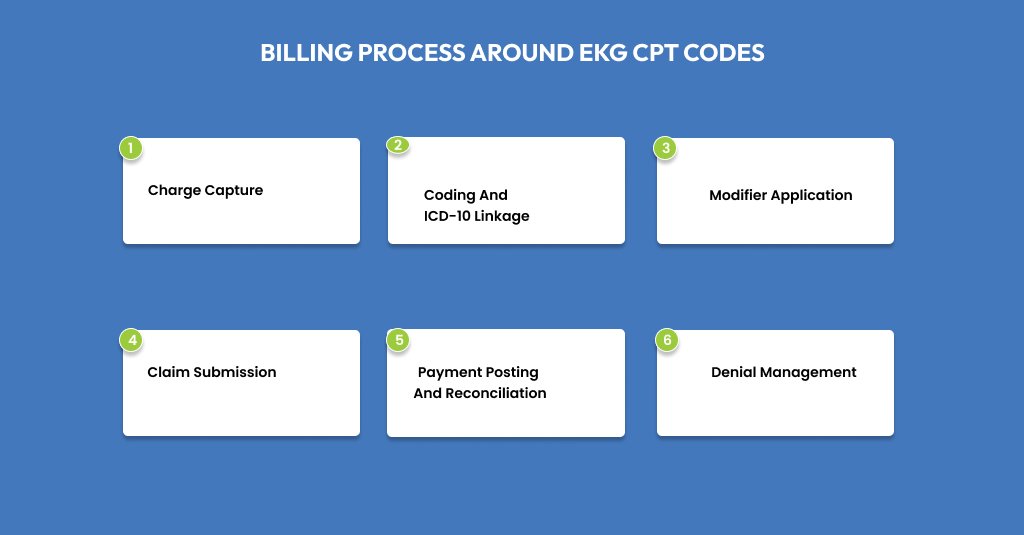
Billing for EKGs follows a structured workflow where CPT codes are central:
Step 1: Charge Capture
After the EKG is performed, the service must be accurately captured in the billing system. This includes:
- Correct CPT code(s) for the service
- Units (if multiple EKGs are performed)
- Any required modifiers (e.g., 26 or TC)
Example: A patient has both a resting EKG and a stress EKG on the same day. CPT 93000 and 93015 may both be billed, but modifier 59 may be required to indicate distinct procedures.
Step 2: Coding and ICD-10 Linkage
Every CPT code must be linked to an ICD-10 code that justifies the procedure. Common examples include:
- R07.9 – Chest pain, unspecified
- R00.0 – Tachycardia, unspecified
- I49.9 – Cardiac arrhythmia, unspecified
Linking CPT and ICD-10 codes is critical for verifying medical necessity. Payers routinely check this relationship, and a mismatch can trigger denials or downcoding.
Step 3: Modifier Application
Modifiers clarify special circumstances:
- 26: Professional component (interpretation and report)
- TC: Technical component (tracing only)
- 59: Distinct procedural service for multiple EKGs or other tests on the same day
Detailed Explanation: Proper modifier usage ensures payment for each component. For example, billing 93005 (technical) and 93010 (professional) without modifiers may confuse the payer and result in underpayment.
Step 4: Claim Submission
Claims are submitted using:
- CMS-1500 for outpatient/professional services
- UB-04 for inpatient/facility services
Each claim must include CPT codes, ICD-10 codes, modifiers, units, dates, and place of service. Supporting documentation may be attached upon payer request.
Clean claims reduce payer edits, prevent denials, and accelerate reimbursement. For example, submitting 93000 with all required information ensures the payer knows the service was performed and medically necessary.
Step 5: Payment Posting and Reconciliation
After payment is received:
- Post payment to the patient account
- Compare expected reimbursement vs actual payment based on CPT code and payer schedule
- Investigate discrepancies for underpayment, missing modifiers, or coding errors
Medicare reimbursement in 2026 is roughly $20–$25 for CPT 93000, and $12–$15 for 93005 or 93010. Posting errors can delay the identification of payment issues.
Step 6: Denial Management
Insurance Claim Denials may occur due to CPT/ICD mismatch, missing modifiers, or duplicate services. Staff should:
- Review each denial
- Verify CPT coding and documentation
- Correct and resubmit promptly
Timely follow-up helps maintain cash flow and reduces write-offs for EKG services.
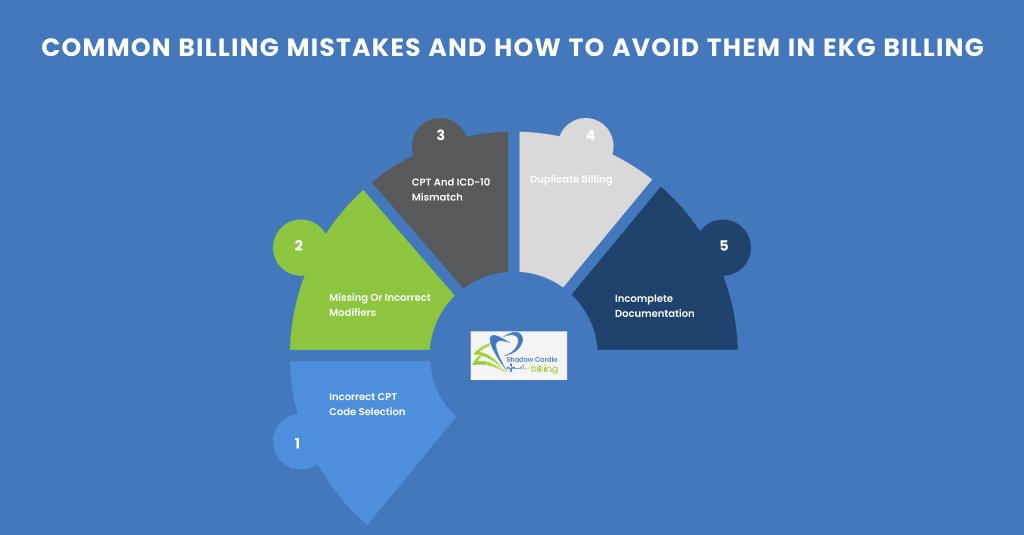
Common Billing Mistakes and How to Avoid Them in EKG Billing
Electrocardiograms look simple on the surface. The test takes a few minutes. The tracing prints out. The provider signs the report. But when it comes to billing, even routine EKGs can create steady revenue leaks if coding and documentation are not handled correctly.
I have seen practices lose thousands every month just because someone selected the wrong CPT code or forgot a modifier. These are not dramatic compliance failures. They are small oversights. Yet they quietly increase denials, delay payments, and trigger payer audits.
Let’s break down the most common EKG billing mistakes and, more importantly, how to avoid them in real-world practice.
Incorrect CPT Code Selection
This is hands down the most frequent EKG billing error. EKG services have three main CPT codes:
- 93000 – Electrocardiogram, routine ECG with at least 12 leads; with interpretation and report (global service)
- 93005 – Tracing only, without interpretation and report (technical component)
- 93010 – Interpretation and report only (professional component)
Many offices automatically bill 93000 for every EKG. That works only if the same provider performs both the technical portion and the interpretation, and the practice owns the equipment.
The problem happens in split-billing situations. For example:
- A hospital performs the tracing.
- A cardiologist later reads and interprets it.
If the cardiologist bills 93000 instead of 93010, the claim will likely be denied. Why? Because the technical component already belongs to the facility.
How to Avoid This Error:
Start by verifying exactly what service your practice performed:
- Did you perform both tracing and interpretation? Bill 93000.
- Did you only perform the tracing? Bill 93005.
- Did you only interpret? Bill 93010.
Train your billing team to confirm the service location and provider role before submitting the claim. Never assume global billing applies. Always confirm.
This small step alone can significantly reduce avoidable denials.
Missing or Incorrect Modifiers
Modifiers are where many clean EKG claims go wrong.
The most common modifier issues involve:
- Missing Modifier 26 (Professional Component)
- Missing Modifier TC (Technical Component)
- Misuse of Modifier 59
When services are split, payers require modifiers to identify which component is being billed.
For example:
- A cardiologist reading an EKG performed elsewhere should report 93010, or if required by payer edits, append Modifier 26 when billing a code that includes both components.
- The facility performing only the technical portion may append TC if billing a code that requires component distinction.
Incorrect use of Modifier 59 is another problem. Modifier 59 should only be used when services are truly distinct and separately identifiable. Using it to bypass bundling edits without documentation is risky and may trigger audits.
How to Avoid This Error
You need consistency between documentation and modifier use.
Make sure your team:
- Understands the difference between global, technical, and professional components.
- Applies 26 and TC only when appropriate.
- Uses Modifier 59 strictly when services are separate and medically necessary.
Run periodic internal audits. Compare documentation against modifier usage. Small errors repeated daily become large revenue losses over time.
CPT and ICD-10 Mismatch
An EKG without a supporting diagnosis will almost always raise a red flag.
Payers do not reimburse diagnostic tests unless medically necessary. Even routine or preoperative EKGs must be linked to an appropriate ICD-10 code.
Common EKG-related diagnoses include:
- Chest pain (R07.9)
- Palpitations (R00.2)
- Shortness of breath (R06.02)
- Preoperative cardiovascular examination (Z01.810)
Problems arise when:
- A vague diagnosis is used.
- A screening code is submitted where the payer does not cover screening EKGs.
- The diagnosis does not logically support the procedure.
For example, billing an EKG with a non-cardiac diagnosis unrelated to symptoms can result in denial for lack of medical necessity.
How to Avoid This Error
Before submitting claims:
- Confirm the ICD-10 code supports the EKG.
- Ensure the provider documentation clearly explains the clinical reason.
- Verify payer policies for screening or preventive EKG coverage.
Remember, Medicare and many commercial plans do not routinely cover screening EKGs unless part of a covered preventive service.
Always connect the dots between symptoms, assessment, and the test ordered.
Duplicate Billing
Duplicate billing often happens unintentionally.
Examples include:
- Billing multiple EKGs on the same day without justification.
- Submitting the same claim twice.
- Failing to use appropriate modifiers when repeat testing is clinically required.
Sometimes a patient’s condition changes, requiring a repeat EKG. That is legitimate. But without documentation and proper modifiers, the payer sees it as duplication.
How to Avoid This Error
If multiple EKGs are performed on the same day:
- Clearly document why each was medically necessary.
- Use appropriate modifiers such as Modifier 59 when services are distinct.
- Ensure timestamps or clinical notes support repeat testing.
Also, implement claim scrubber edits in your billing software. These tools flag duplicate charges before submission.
Clean claims start with prevention, not appeals.
Incomplete Documentation
This mistake fuels almost every denial category.
Documentation that states “EKG performed” is not enough.
A compliant EKG report should include:
- Type of EKG performed
- Number of leads (typically 12-lead)
- Technical component confirmation
- Interpretation details
- Clinical findings
- Provider signature
- Date of service
If interpretation is billed, the report must clearly document the interpretation, not just a tracing attached to the chart.
Incomplete documentation can lead to:
- Medical necessity denials
- Downcoding
- Audit recoupments
- Compliance exposure
How to Avoid This Error
Educate providers on what payers expect in an EKG interpretation report.
Encourage structured templates that prompt:
- Rhythm analysis
- Rate
- Axis
- Intervals
- Clinical impression
Clear documentation protects revenue. It also protects the provider during audits.
Following these practices reduces denials, maximizes reimbursement, and ensures compliance with payer and regulatory requirements.
Reimbursement Insights & Revenue Impact
EKG reimbursement may seem modest on paper, but volume changes everything.
For example:
-
CPT 93000 (global) averages $20–$25 under Medicare.
-
CPT 93005 or 93010 individually average $12–$15.
If a cardiology practice performs 20 EKGs per day, even a 5% denial rate can result in thousands of dollars in lost revenue annually.
When CPT selection, modifier use, or ICD-10 linkage is inaccurate, denials multiply quietly. Over time, these small losses create measurable revenue leakage.
Accurate medical coding is not just compliance, it is financial strategy.
Conclusion
While EKGs may appear routine, billing errors are common and can significantly impact revenue. Accurate CPT selection, proper modifier use, correct ICD-10 linkage, and thorough documentation are critical. A structured billing workflow—from charge capture to claim submission, payment posting, and denial resolution ensures efficient revenue cycle management and compliance.
By implementing these steps and avoiding common pitfalls, cardiology practices can streamline EKG billing, prevent denials, and maintain healthy cash flow.
Frequently Asked Questions About EKG Billing
Does Medicare cover routine screening EKGs?
Medicare generally does not cover routine screening EKGs unless part of specific preventive services. Medical necessity must be documented.
Can CPT 93000 and 93015 be billed together?
Yes, if medically necessary and distinct. Modifier 59 may be required depending on payer edits.
When should modifier 26 be used for EKG?
Modifier 26 is used when billing only the professional interpretation component.
What documentation is required for CPT 93010?
A signed interpretation report with findings, clinical impression, and date of service is required.
Optimize Your Cardiology Revenue Cycle with Expert EKG Billing Support
EKG billing errors may seem minor — but repeated mistakes can silently drain thousands of dollars in revenue every year.
At Shadow Cardiology Billing Services, we specialize in cardiology-specific coding, CPT optimization, and denial prevention strategies. Our team understands:
✔ EKG CPT coding nuances (93000–93227)
✔ Modifier 26/TC compliance
✔ NCCI bundling edits
✔ Medicare LCD requirements
✔ ICD-10 medical necessity linkage
✔ Stress test and ambulatory monitoring billing
✔ High-volume cardiology workflows
We don’t just submit claims — we protect your reimbursement and reduce audit risk.
If your cardiology practice is experiencing:
-
Frequent EKG denials
-
Underpayments
-
Documentation-related rejections
-
Modifier confusion
-
High A/R days
It’s time to implement a smarter billing strategy.
Let Shadow Cardiology Billing Services audit your EKG billing process and identify hidden revenue gaps.
Schedule a Free Billing Assessment
– Get a Customized Revenue Review
– Improve Clean Claim Rates
– Reduce Denials
Contact Shadow Cardiology Billing Services today and turn routine EKG billing into predictable, optimized revenue.