Cardiology billing requires precision, knowledge, and attention to detail. From routine office visits to high-risk interventions like PCI or device implantation, every CPT code must accurately reflect the service provided, support medical necessity, and comply with payer rules. Coding or documentation errors can delay payments, trigger denials, and even increase audit risk. This guide walks you through cardiology CPT coding, documentation best practices, billing workflows, and common pitfalls to help your practice maximize revenue and maintain compliance.
Understanding Cardiology CPT Coding
Cardiology CPT coding involves assigning the correct Current Procedural Terminology (CPT) codes to services the provider performs. You must know what the provider did, not what you think they did.
These are the main areas you’ll encounter:
Let’s discuss in detail:
Evaluation & Management (E/M) Services
Cardiology office visits are reported with E/M codes from 99202–99215. These involve consultation, history, exam, and medical decision-making (MDM).
Key points:
- Choose the level based on time OR MDM complexity (per 2023–2026 E/M guidance).
- Include all components: history, exam, and clinical decision-making.
- Don’t upcode. High levels require clear documentation that clearly shows risk, complexity, and data interpretation.
Example: A patient with unstable angina seen urgently requires a higher E/M level because of complex decision-making and risk.
Cardiac Imaging & Non-Invasive Tests
Cardiology includes many diagnostic tests:
- Echo (CPT 93306–93351)
- Stress testing (CPT 93015–93018)
- Holter monitors / event monitors (CPT 93224–93227, 93268–93270)
These codes are not interchangeable; each represents a specific service with defined documentation requirements.
Documentation must support:
- Indication for the test
- Technical components vs. professional interpretation
- Mode (rest, stress, contrast, Doppler, etc.)
Example: CPT 93306 = transthoracic echocardiography with Doppler and color flow, complete study.
The report must include key measurements: chamber sizes, valve sizes, gradients, and Doppler findings.
Vascular Studies
Peripheral vascular studies include:
- CPT 93922–93979 for arterial and venous duplex and limited studies.
Unlike EKGs or basic echoes, vascular studies require:
- Clear indication (e.g., claudication, DVT suspicion)
- Laterality
- Specific vessels examined
Documentation without specifics often leads to payers downgrading the service.
Cardiac Catheterization & Interventional Coding
These are high-value, high-documentation procedures.
Examples:
- CPT 93454 – Coronary angiography with left heart cath and imaging of coronary arteries
- CPT 92928 – Percutaneous transcatheter placement of an intracoronary stent
Interventional coding must reflect:
- Access site (femoral vs. radial)
- Number of vessels treated
- Device placement (stents, atherectomy, etc.)
- Whether PCI was one or more vessels
This is where cardiology can make or break revenue.
Bundling Rules & Multi-Vessel PCI Nuances
Interventional cardiology coding is not just about selecting 92928.
Coders must understand:
-
Whether PCI was performed on one vessel or multiple vessels
-
Whether additional stents were placed
-
Whether atherectomy or thrombectomy was performed
-
Whether imaging guidance was bundled
Many PCI-related services are subject to NCCI bundling rules. Some services are inherently included in primary codes, while others may qualify as add-on codes.
For example:
-
Coronary angiography may be bundled depending on context.
-
Imaging supervision and interpretation may not be separately billable.
-
Access site closure devices are often bundled.
Failure to understand bundling can lead to:
-
Underbilling
-
Denials
-
Unnecessary appeals
-
Compliance risk if incorrectly unbundled
High-value cardiology procedures require both coding precision and payer familiarity.
Rhythm Management & Device Coding
Pacemakers and ICDs involve:
- Insertion (CPT 33206–33249)
- Generator changes (CPT 33262–33263)
- Lead revisions (CPT 33212–33233)
These procedures carry high RVUs and strict documentation requirements.
Make sure notes include:
- Device type
- Reason for placement
- Leads inserted and positions
- Any testing performed
Devices are a favorite area for audits because documentation is often lacking in detail.
Reimbursement, RVUs & Why CPT Accuracy Matters in Cardiology
Cardiology is one of the highest RVU-generating specialties in outpatient and interventional care. However, high reimbursement also means higher scrutiny.
For example:
-
E/M visit (99214) carries moderate RVUs.
-
Transthoracic echo (93306) significantly increases reimbursement.
-
PCI with stent placement (92928) carries substantially higher RVUs.
-
Device implantation codes (33206–33249) represent high-dollar claims.
When CPT selection does not match documentation, the impact is significant:
-
Downcoding reduces revenue.
-
Bundling edits reduce payment.
-
Missing modifiers result in denials.
-
Incorrect vessel reporting lowers reimbursement.
-
Overcoding increases audit exposure.
CMS and commercial payers apply NCCI (National Correct Coding Initiative) edits to prevent improper unbundling. If coders do not understand bundling rules, legitimate services may be denied or incorrectly written off.
In cardiology, CPT precision directly affects cash flow, compliance, and audit risk.
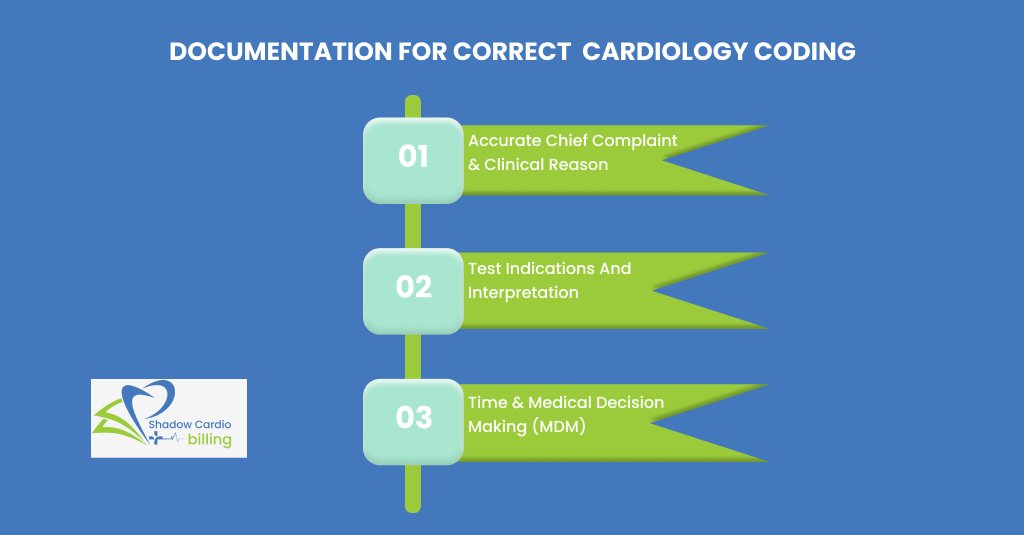
Documentation for Correct Cardiology Coding
Coding is only as good as the documentation you have. In cardiology, many codes look similar on paper but require subtle differences in notes.
Here’s what must be documented every single time:
Accurate Chief Complaint & Clinical Reason
Generic complaints like “chest pain” are not enough. The note should show:
- Onset, location, quality, severity
- Associated symptoms (SOB, diaphoresis, dizziness)
- Risk factors (HTN, diabetes, smoking, family history)
This supports the E/M level and tests ordered.
Test Indications and Interpretation
“Suspected heart failure. Echocardiography performed showed LVEF 35%, mild mitral regurgitation, and no pericardial effusion.”
Interpretation must be clear, not just “echo done.”
For cath labs or device work:
Include:
- Access site
- Number of vessels evaluated
- Lesion location and severity
- Devices placed or not placed
- Any complications
- Post-procedure status
This supports complex procedural codes, such as stenting or atherectomy.
Time & Medical Decision Making (MDM)
For E/M, providers must document:
- Amount of data reviewed
- Complexity of problem(s)
- Risk of morbidity/mortality
- Conversation with patient
Without this, CPT 99214 or 99215 won’t withstand scrutiny.
Cardiology Billing Workflow
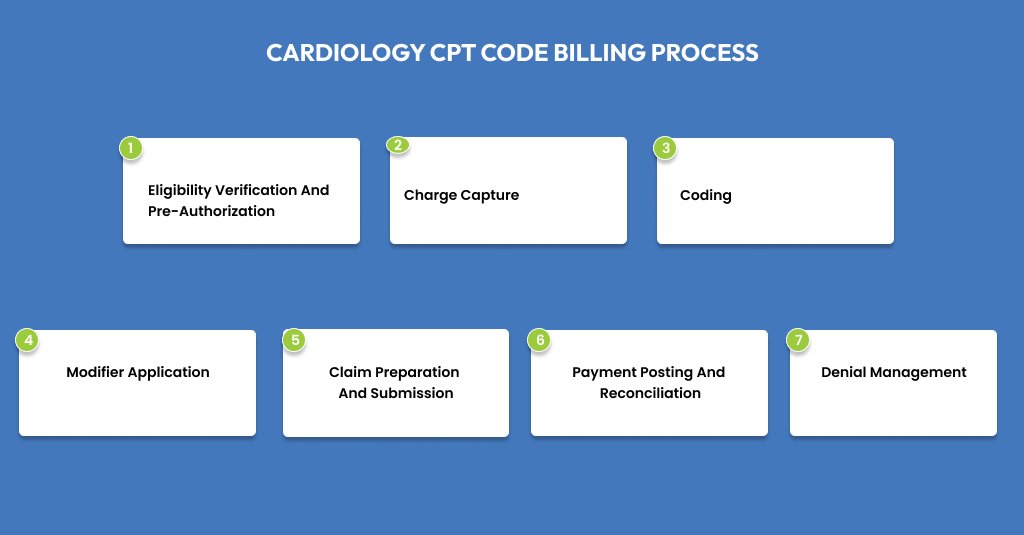
Cardiology billing is highly dependent on accurate CPT coding. Every service performed, from a routine E/M visit to a complex cardiac catheterization or device implantation, relies on CPT codes to drive reimbursement. A small coding error can delay payment, trigger denials, or even risk audits. Below is a detailed, step-by-step guide to the billing process with supporting explanations, practical tips, and real-world examples.
Eligibility Verification and Pre-Authorization
The billing process begins before the patient is seen.
Verifying eligibility and benefits ensures that the cardiology services provided will be reimbursed.
CPT codes determine which procedures require pre-authorization, which is critical for high-cost services such as echocardiograms (CPT 93306), stress tests (CPT 93015), coronary angiography (CPT 93454), or pacemaker insertions (CPT 33206).
For example, if a patient is scheduled for a percutaneous coronary intervention (CPT 92928), confirming insurance coverage and obtaining pre-authorization prevents the claim from being denied for “lack of prior approval.”
This early step also helps practices educate patients about out-of-pocket costs, minimizing surprise bills, and improving patient satisfaction. Pre-billing diligence around CPT codes sets the foundation for a smoother revenue cycle.
Charge Capture
Once the cardiology service is delivered, accurate charge capture is the next critical step. Every service, test, or procedure performed must be documented and linked to the appropriate CPT code. This includes office visits (99202–99215), imaging (e.g., 93306), vascular studies (93922–93979), interventional procedures (93454, 92928), and device management (33206–33233).
Charge capture is more than just entering a code; it ensures that each CPT code accurately reflects what the provider did. For instance, if a patient receives a transthoracic echocardiogram with Doppler, entering only a generic echocardiography code without the Doppler component could result in underpayment. Similarly, capturing a PCI procedure without specifying whether a stent was placed or which vessel was treated can lead to denials. Charge capture accuracy is the backbone of revenue recognition.
Cardiology Coding
After charge capture, coders must ensure that every CPT code is paired with an ICD-10 diagnosis code that supports medical necessity. Payers review CPT-ICD alignment to verify that services are clinically justified.
For example, a transthoracic echo (CPT 93306) for a patient with heart failure should be linked to I50.9 (Heart failure, unspecified). If a PCI (CPT 92928) is performed, the ICD-10 code should indicate the relevant coronary artery disease diagnosis, such as I25.110 (Atherosclerotic heart disease of native coronary artery with unstable angina). Failing to link CPT codes with the correct ICD-10 diagnosis can result in claim denials, delayed payments, or reduced reimbursement. Accurate coding ensures claims reflect the true scope of services delivered and supports compliance in audits.
Modifier Application
Modifiers clarify the circumstances of the CPT-coded services and can significantly affect reimbursement. Commonly used modifiers in cardiology include:
- 25: Indicates a separately identifiable E/M service performed on the same day as a procedure.
- LT/RT: Identifies laterality, which is crucial for interventions on specific vessels or device placements.
- 59: Indicates a distinct procedural service when a procedure is usually bundled.
For instance, if a patient undergoes an E/M visit (99214) on the same day as a stress echocardiogram (93350), modifier 25 ensures that the visit is reimbursed separately. Without proper modifier use, payers may bundle services or reject claims, directly affecting revenue. Correct modifier application safeguards both compliance and complete payment.
Claim Preparation and Submission
Once coding and modifiers are finalized, claims are prepared for submission. Professional services use CMS-1500 forms, while inpatient or facility claims are submitted via UB-04 forms. Every CPT code must be included along with ICD-10 codes, modifiers, units, dates, and the place of service.
Supporting documentation, such as operative notes, echocardiogram interpretations, and cath lab reports, should be attached when required by payers. Clean claims that accurately reflect CPT-coded services are less likely to trigger payer edits or denials. For example, submitting a PCI claim with all required CPT codes, modifiers, and supporting documentation ensures the claim aligns with the payer’s medical-necessity rules, thereby improving the speed and accuracy of reimbursement.
Payment Posting and Reconciliation
Once payment is received, it must be posted to the patient account. Each CPT code has a corresponding expected reimbursement rate based on Medicare, Medicaid, or commercial fee schedules. Discrepancies between expected and actual payment may indicate coding errors, missing modifiers, or payer processing issues.
For example, if a PCI (CPT 92928) is reimbursed at a level below expectations, reconciliation may reveal a missing LT/RT modifier or a mismatch between the CPT and ICD-10 codes. Accurate CPT coding ensures straightforward payment posting, minimizes disputes, and keeps the revenue cycle healthy.
Denial Management
Despite careful coding, denials may still occur. Common CPT-related denial reasons include:
- CPT code not covered under the patient’s plan
- CPT/ICD-10 mismatch
- The CPT code is considered bundled with another procedure.
AR or billing staff must review each denial, verify documentation, correct CPT coding if necessary, and resubmit. Timely follow-up, especially for high-value procedures like PCI or device implantation, ensures maximum revenue recovery. For example, a denied pacemaker insertion (CPT 33206) might be resubmitted with clarified documentation that specifies the device type, access site, and clinical necessity.
Cardiology Billing Mistakes and How to Avoid Them
Cardiology billing is high-stakes. Mistakes in CPT coding can lead to claim denials, delayed payments, underpayment, or even audits. Many of these errors are avoidable with proper documentation, coding practices, and proactive checks. Here’s a detailed look at the most common mistakes and how to prevent them.
Incorrect E/M Level Coding
One of the most frequent mistakes in cardiology billing involves mis-coding Evaluation & Management (E/M) visits. Providers may document a routine visit, but coders sometimes assign a higher-level CPT code, such as 99214 or 99215, without sufficient documentation of medical decision-making (MDM) or time spent.
Payers may deny or downcode claims, resulting in reduced reimbursement and potentially triggering audits.
How to Avoid: Coders and billers must verify that the provider’s documentation supports the level billed. Ensure that history, exam, and MDM (or total time for time-based coding) are clearly documented. Modifier 25 should be used correctly when an E/M visit occurs on the same day as a procedure.
Using the Wrong CPT Code for Procedures
Cardiology procedures are nuanced. Mis-coding can occur when coders select a general code rather than a specific CPT code that reflects the actual procedure.
Incorrect CPT codes can result in underpayment, claim denials, or improper reimbursement. For example, using a generic CPT code for “echocardiography” instead of the specific CPT code for “transthoracic echo with Doppler” (93306) may result in payers reducing reimbursement.
How to Avoid: Always reference CPT code definitions and ensure the documentation supports every element of the code. For complex procedures such as PCI or stent placement, confirm the vessel, access site, and device type. Keep CPT manuals and electronic coding tools up to date.
Incorrect or Missing Modifiers
Modifiers are critical in cardiology billing but are often misused. Common errors include missing modifiers (LT, RT, 25, 59) or misapplying them.
Claims may be denied for duplicate services, unbundling, or procedures incorrectly separated. Missing a modifier could mean the practice is not reimbursed for legitimate work.
How to Avoid: Coders must verify laterality and procedural distinctions. Modifier 25 is necessary when an E/M visit is performed on the same day as a procedure, and modifier 59 should only be used for distinct procedural services. Regular training and claim edits can prevent repeated mistakes.
CPT and ICD-10 Mismatch
Many denials occur because the submitted CPT code does not match the ICD-10 diagnosis code. Payers review medical necessity, and if the diagnosis does not support the procedure, payment may be reduced or denied.
Even if the procedure was medically necessary, improper linkage can lead to claim rejection or delays.
How to Avoid: Review the documentation to ensure each CPT code is supported by an appropriate ICD-10 diagnosis. Coders should link the correct diagnosis to each procedure. For example, a PCI (CPT 92928) should be connected to an ICD-10 code for atherosclerotic heart disease, not a non-specific chest pain code.
Incomplete Documentation
Vague documentation is one of the most common and costly mistakes. Notes like “heart procedure done” or “chest pain evaluated” are insufficient.
Impact: Without detailed documentation, coders cannot assign correct CPT codes. Payers may deny services due to a lack of medical necessity. Repeated incomplete documentation also increases audit risk.
How to Avoid: Providers must document the specific procedure, the site of intervention, the vessels treated, the devices used, the test interpretations, and the clinical decision-making. Coders should query providers for clarification when documentation is insufficient.
Failure to Pre-Authorize High-Cost Procedures
Procedures like PCI, device implantation, or stress testing often require payer pre-authorization. Billing without approval is a common mistake.
Claims may be rejected outright, leaving the patient liable for costs.
How to Avoid: Billing teams should confirm pre-authorization before procedures, document approval numbers, and link them to the CPT code being billed. Automating pre-auth verification for high-cost CPT codes can prevent delays.
Compliance & Audit Risk in Cardiology Billing
Cardiology is frequently targeted in payer audits due to:
-
High reimbursement procedures
-
Device implantation
-
Multi-vessel PCI billing
-
E/M level selection
-
Modifier 25 usage
Common audit triggers include:
-
E/M billed on same day as procedure without clear documentation
-
Device procedures lacking lead documentation
-
Incomplete cath lab reports
-
Unclear laterality
-
CPT/ICD mismatch
CMS contractors and commercial payers use data analytics to flag outliers in RVU patterns.
For example:
A practice billing unusually high rates of 99215 compared to peers may trigger review.
Preventive strategies include:
-
Monthly internal coding audits
-
Modifier review processes
-
Structured documentation templates
-
Regular CPT update training
-
Proactive denial pattern analysis
Compliance is not about fear. It is about documentation clarity and coding accuracy.
Frequently Asked Questions About Cardiology CPT Coding
What are the most commonly used cardiology CPT codes?
Common codes include 99202–99215 (E/M), 93306 (echo), 93015 (stress test), 93454 (cath), 92928 (PCI), and 33206 (pacemaker insertion).
Why are cardiology claims often denied?
The most common reasons include CPT and ICD-10 mismatch, missing modifiers (25, 59, LT/RT), bundling edits, and lack of pre-authorization.
How can cardiology practices reduce audit risk?
By ensuring documentation supports CPT codes, following NCCI bundling rules, performing periodic coding audits, and training providers on E/M requirements.
What is the biggest revenue leak in cardiology billing?
Undercoding, missed modifier usage, and incomplete charge capture often result in significant lost revenue over time.
Protect Your Cardiology Revenue with Specialized Billing Support
Cardiology billing is not general medical billing. It requires specialty knowledge, payer rule awareness, and precision in CPT coding.
Even small errors in:
-
PCI documentation
-
Device implantation notes
-
Modifier application
-
CPT/ICD linkage
-
Bundling interpretation
Can result in thousands of dollars in lost revenue or audit exposure.
At Shadow Cardio Billing, we specialize exclusively in cardiology revenue cycle management.
Our team understands:
✔ Complex interventional CPT coding
✔ NCCI bundling rules
✔ Modifier 25 and 59 compliance
✔ Multi-vessel PCI billing
✔ Device implantation documentation
✔ Denial recovery strategies
✔ Clean claim optimization
We do not just submit claims.
We protect revenue and reduce risk.
If your cardiology clinic is experiencing:
-
High denial rates
-
Underpayments
-
AR aging issues
-
Coding uncertainty
-
Audit concerns
It may be time for a specialized review.
Request a Free Cardiology Billing Assessment Today
Let us identify revenue gaps and compliance risks before payers do.