
Running a small cardiology clinic is not easy. You are balancing patient care, diagnostics, compliance, staffing, billing, and cash flow, often with limited resources. Unlike large hospital systems, small practices cannot afford inefficiencies. Every missed charge, delayed claim, or scheduling gap directly impacts revenue.
The good news is this: small cardiology clinics can run efficiently and profitably when the right systems, workflows, and habits are in place. Efficiency is not about cutting corners. It is about reducing friction, avoiding repeat work, and making smart operational decisions that support both care quality and financial health.
This guide walks through proven best practices to manage a small cardiology clinic efficiently, step by step, from front desk to billing, compliance, and growth.
How to Manage a Small Cardiology Clinic Effectively
It’s important to understand that managing a small cardiology clinic efficiently doesn’t rely on a single big change. It depends on a series of small, well-executed practices that work together across scheduling, clinical documentation, billing, compliance, and patient communication. When even one part of the workflow breaks down, the impact is felt across the entire clinic, from delayed payments to frustrated Staff and patients.
The best practices below focus on building a structure where chaos usually exists. They help small cardiology clinics streamline daily operations, reduce avoidable errors, and maintain consistent cash flow while staying compliant with payer and regulatory requirements.
Build Strong Front-Desk and Scheduling Workflows
Efficiency starts at the front desk. Many cardiology clinics lose revenue before patients ever see the provider. Poor scheduling, missed eligibility checks, and unconfirmed appointments create gaps that are hard to recover later.
A small cardiology clinic should run structured scheduling, not reactive scheduling. Appointments must be categorized clearly. New patients, follow-ups, diagnostic testing (EKGs, echoes, stress tests), and procedures should each have defined time slots. This prevents overbooking and provider burnout.
Eligibility verification must happen before the visit, not on the day of service. Front-desk staff should confirm insurance coverage, deductible status, copays, and referral requirements 24–48 hours in advance. This step alone reduces denials and patient payment disputes.
Appointment reminders are not optional. Automated calls or texts significantly reduce no-shows, especially for diagnostic visits. For small clinics, even a single missed stress test appointment can cost hundreds of dollars.
Clinics that confirm eligibility and appointments in advance typically see 15–25% fewer denials and improved patient satisfaction.
Standardize Clinical Documentation Without Slowing Providers
Cardiology documentation must be specific, complete, and timely, without slowing providers down. The key is standardization, not longer notes.
Templates should be built for:
- Office visits (E/M)
- EKG interpretations
- Echocardiograms
- Stress testing
- Follow-up visits
- Device checks
Each template should prompt providers to document:
- Reason for visit
- Medical decision-making
- Diagnostic findings
- Interpretation and impression
- Plan of care
Incomplete documentation leads to downcoding, denied claims, and audit risk. On the other hand, overly verbose notes waste time. The goal is clear, defensible documentation that supports CPT coding.
Small clinics should also establish a documentation completion timeline, ideally the same day or within 24 hours. Delayed notes delay billing. Delayed billing delays cash flow.
Clinics that finalize notes within 24 hours reduce AR days by 20–30%.
Master CPT-Driven Cardiology Billing
Cardiology revenue depends heavily on accurate CPT coding. Small clinics often lose money not because they see fewer patients, but because CPT codes are missed, undercoded, or billed incorrectly.
Each service must be reviewed for:
- Correct CPT code
- Proper ICD-10 linkage
- Modifier usage (26, TC, 25, 59, LT/RT)
- Documentation support
For example, EKG billing must distinguish between:
- Technical component
- Professional component
- Combined services
E/M visits billed on the same day as diagnostic testing must be supported by separate documentation and modifier 25 when appropriate. Missing this step leads to automatic denials.
Small clinics benefit from charge capture audits, even monthly. This ensures that stress tests, echoes, Holter monitoring, and device checks are not slipping through the cracks.
Under-coding is more common than over-coding in small cardiology clinics—and it quietly drains revenue every month.
Implement a Clean Claim Submission Process
Efficiency in billing means submitting clean claims the first time. Reworking claims is expensive and time-consuming.
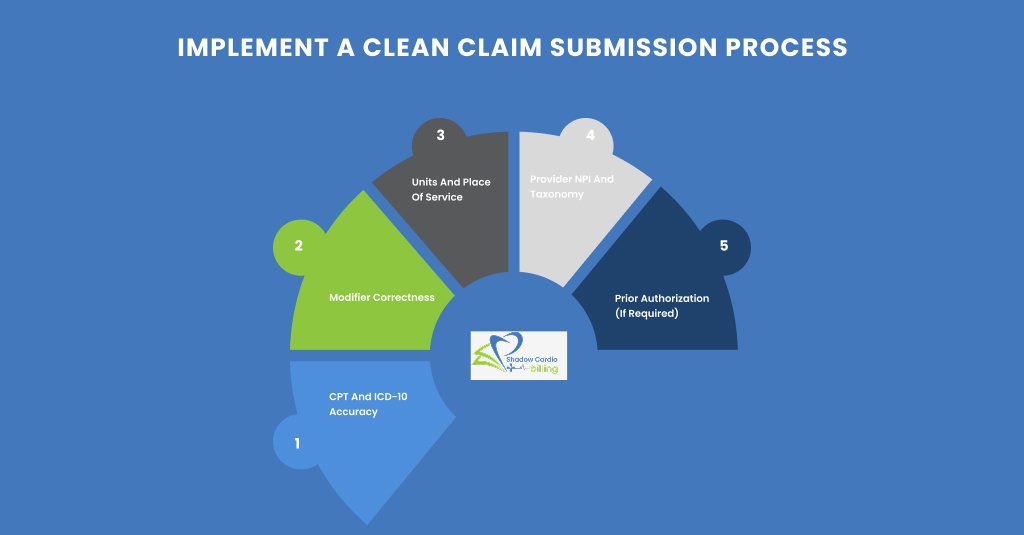
Before submission, every claim should be checked for:
- CPT and ICD-10 accuracy
- Modifier correctness
- Units and place of service
- Provider NPI and taxonomy
- Prior authorization (if required)
Small clinics should use claim scrubbing tools or clearinghouse edits to catch errors early. Even basic edits can prevent denials related to missing modifiers or invalid diagnosis links.
Claims should be submitted daily, not in batches at the end of the week. Daily submissions improve cash flow and help identify payer issues faster.
Clinics that submit claims daily typically receive payments 5–7 days faster than those that delay submission.
Actively Manage Claim Denials and Accounts Receivable
Insurance Claim Denials are not just a billing problem. They are an efficiency problem. Ignored denials turn into lost revenue.
Every cardiology clinic should track:
- Denial rate
- Top denial reasons
- Aging AR buckets
- High-dollar unpaid claims
Insurance Claim Denials Management must be worked on quickly and systematically. High-value claims such as stress tests, catheterizations, or device services should be prioritized.
Common cardiology denial causes include:
- CPT/ICD mismatch
- Missing modifier 25
- No prior authorization
- Medical necessity issues
When patterns appear, workflows must be corrected upstream. Fixing the root cause is more efficient than repeatedly appealing the same denial type.
Clinics that address denials within 7–10 days recover significantly more revenue than those that wait 30+ days.
Improve Patient Payment Collection Without Conflict
Patient balances are rising, especially with high-deductible plans. Efficient clinics handle patient collections professionally and transparently.
Patients should be informed of estimated costs before services when possible. Copays and deductibles should be collected at check-in, not after the claims process.
Clear financial policies reduce confusion. Staff should be trained to explain bills calmly and confidently. Payment plans help reduce bad debt without damaging patient relationships.
Statements should be clear, timely, and consistent. Confusing bills lead to delays and disputes.
Clinics that collect patient responsibility upfront reduce bad debt by up to 30%.
Stay Compliant Without Overcomplicating Operations
Compliance does not have to be overwhelming. Small cardiology clinics can stay compliant by focusing on core risk areas.
Key compliance priorities include:
- Accurate CPT coding
- Documentation that supports billed services
- Proper modifier usage
- HIPAA compliance
- Annual CPT and ICD-10 updates
Internal audits should be done periodically, even if informal. Reviewing a small sample of charts each month can catch issues early.
Education matters. Providers and Staff should receive short, focused training updates when codes or payer rules change.
Efficiency insight: Preventive compliance is far less costly than post-payment audits or recoupments.
Use Technology That Fits a Small Clinic
Efficiency improves when technology supports workflows rather than complicates them. Small cardiology clinics do not need enterprise systems, but they do need reliable, integrated tools.
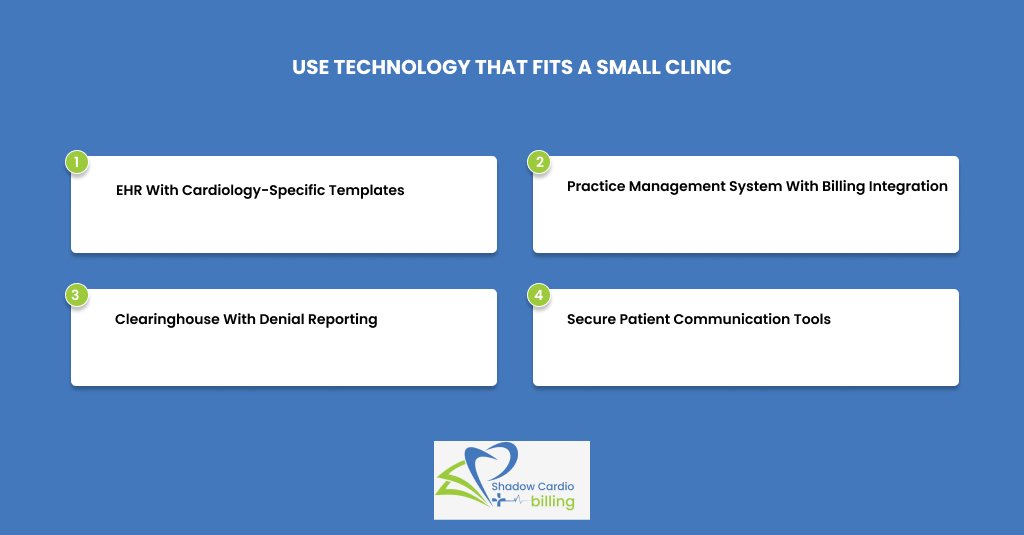
Key technology priorities include:
- EHR with cardiology-specific templates
- Practice management system with billing integration
- Clearinghouse with denial reporting
- Secure patient communication tools
Technology should reduce manual work, not add to it. If Staff are double-entering data, efficiency is already lost.
When to Outsource Cardiology Billing Services
Not every function must be handled in-house. Small clinics often benefit from outsourcing billing, AR follow-up, or coding audits, especially when staffing is limited.
Outsourcing allows providers to focus on care while specialists handle complex payer rules and follow-ups. The key is choosing partners who understand cardiology, not general billing.
Strategic outsourcing often costs less than hiring, training, and managing full-time billing staff.
| Outsource Your Cardiology Billing Services to Shadow Cardio Billing
Cardiology Medical billing is too specialized to leave to trial and error. If your team is stretched thin, Shadow Cardio Billing steps in where it matters most. From CPT accuracy to aggressive AR follow-ups, our cardiology-focused billing specialists work behind the scenes to protect your revenue and speed up payments. You keep complete visibility. We handle the complexity. No long learning curves. No guesswork with payer rules. Just cleaner claims, fewer denials, and steady cash flow without the cost of building a whole in-house billing department. If you’re ready to spend less time chasing reimbursements and more time caring for hearts, Shadow Cardio Billing is built for clinics like yours. |
Frequently Asked Questions
How do you improve efficiency in a small cardiology clinic?
By standardizing scheduling, improving documentation, submitting clean claims daily, managing denials proactively, and optimizing revenue cycle workflows.
What is the biggest revenue challenge for small cardiology clinics?
The most common issue is undercoding and missed charges, followed by denial mismanagement and delayed claim submission.
Should small cardiology clinics outsource billing?
Outsourcing can reduce overhead, improve clean claim rates, and speed up reimbursement when handled by cardiology-focused billing specialists.
How can cardiology clinics reduce claim denials?
By verifying eligibility in advance, using correct CPT codes, applying proper modifiers, and linking services to appropriate ICD-10 diagnoses.
Final Thoughts
Managing a small cardiology clinic efficiently is about systems, not size. Clinics that standardize workflows, document smartly, code accurately, and manage billing proactively can compete with much larger organizations.
Efficiency improves patient care, staff satisfaction, and financial stability. When operations run smoothly, providers can focus on what matters most, treating patients and growing the practice sustainably.